
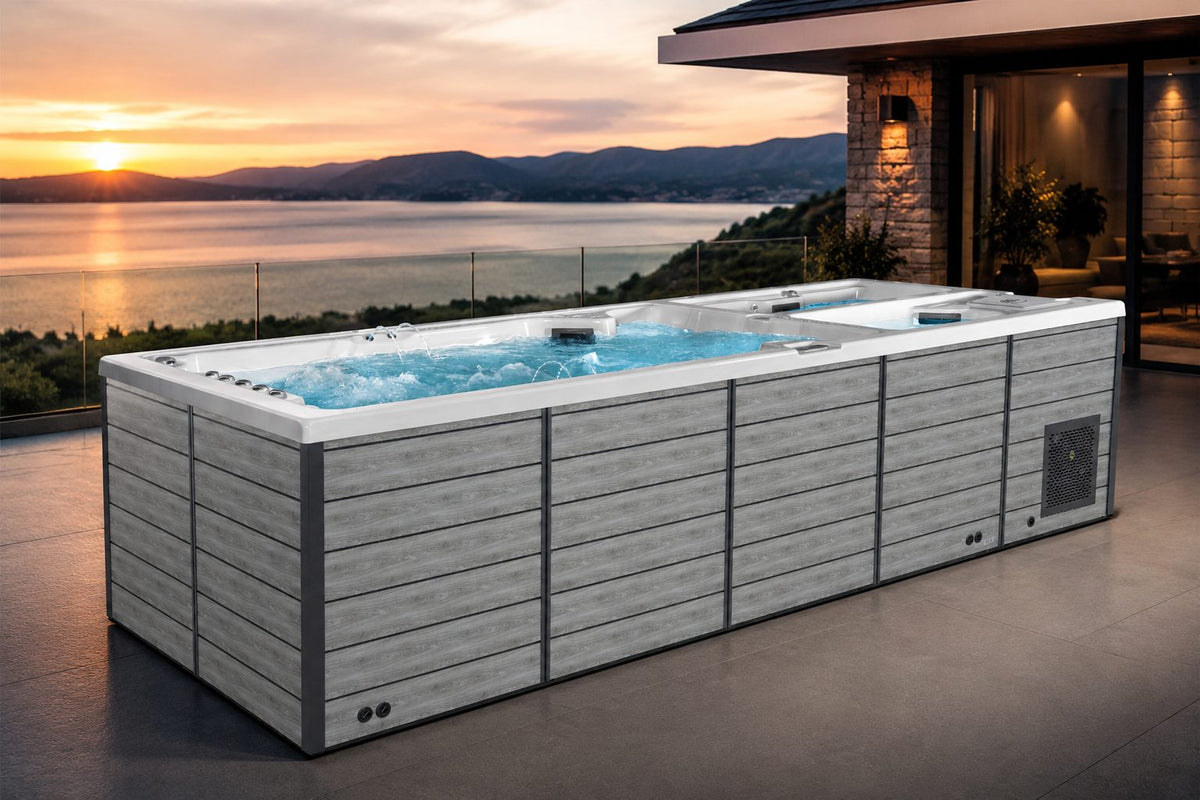
The right spa supplies make the difference between a hot tub that stays clean and comfortable and one that turns into a constant maintenance headache. Seven categories cover the basics: sanitizer, shock, pH and alkalinity balancers, water testing strips, filter care, a quality spa cover, and general cleaning products.
Whether you just bought your first hot tub or you're restocking for the season, this guide explains what each supply does, how often you'll use it, and how the pieces work together to keep your water clear with less effort.
Spa Supplies Checklist at a Glance
|
Spa supply |
What it does |
How often you'll use it |
|
Sanitizer (chlorine or bromine) |
Kills bacteria and other contaminants |
Continuously or several times a week |
|
Shock |
Breaks down oils, lotions, and sweat |
Weekly and after heavy use |
|
pH and alkalinity balancers |
Keep water comfortable and sanitizer effective |
As test results show |
|
Water testing strips |
Show sanitizer, pH, and alkalinity levels |
2 to 3 times a week |
|
Filter cartridges and filter cleaner |
Trap debris and oils |
Rinse weekly, deep clean monthly |
|
Spa cover |
Holds in heat and keeps out debris and sunlight |
Every day the spa isn't in use |
|
Cleaning and maintenance products |
Remove waterline grime, scale, and stains |
As needed and at each drain |
Why Having the Right Spa Supplies Matters
Water chemistry drifts constantly as bathers, weather, and normal use change what's in the water. Without the right spa supplies on hand, small chemical imbalances can turn into cloudy water, odors, skin irritation, or equipment strain before you notice something's off.
Keeping a basic stock means you can respond the moment a problem appears instead of waiting for a delivery while water quality declines. It also saves money, because fixing a small imbalance early takes far less product than correcting one that has been building for days.
1. Sanitizer: Chlorine or Bromine
Sanitizer is the backbone of any spa maintenance routine. Chlorine and bromine both kill bacteria and other contaminants, but they behave a little differently:
|
|
Chlorine |
Bromine |
|
Speed |
Works faster |
Works a bit more slowly |
|
Stability in hot water |
Breaks down faster at spa temperatures |
Stays more stable in hot water |
|
Odor |
Can produce a stronger chemical smell |
Milder odor |
|
Cost |
Usually lower cost per treatment |
Usually costs a little more |
|
Recommended level |
At least 3 ppm free chlorine |
4 to 8 ppm |
Whichever you choose, consistency matters more than the specific type. Running out of sanitizer, even for a day or two, lets contaminants build up faster than most people expect. Keeping a backup supply on hand avoids that gap entirely.
For lower-maintenance sanitizing, mineral systems use minerals together with a reduced amount of chlorine or bromine. The FROG @ease Floating Sanitizing System uses SmartChlor technology, and FROG Serene pairs minerals with bromine cartridges. Traditional options include SpaGuard Chlorinating Concentrate and SpaGuard Brominating Tablets. Browse all hot tub chlorine and bromine options.
2. Shock Treatment
Shock is a concentrated oxidizer that breaks down organic waste, such as body oils, lotions, and sweat, that regular sanitizer alone can't fully handle. Shocking also helps restore your sanitizer's effectiveness and reduces the harsh odor caused by used-up chlorine.
Most owners shock once a week, plus after heavy use, such as a party or several soaks in one day. Keep these tips in mind:
· Non-chlorine shock oxidizes the water without adding more chlorine. FROG Maintain comes in pre-measured single-dose pouches, and SpaGuard Spa Shock Oxidizer is another popular choice.
· Chlorine shock also raises the sanitizer level. SpaGuard Enhanced Shock is designed for spas, and FROG Jump Start is made for freshly filled hot tubs.
· Leave the cover open for a short time after shocking so gases can escape, following the product directions.
Shock is easy to forget until the water already looks or smells off, so keeping a few doses in stock is worth the small investment.
3. pH and Alkalinity Balancers
pH and total alkalinity work together to keep water comfortable and help sanitizer do its job. When pH drifts too high or too low, sanitizer becomes less effective and can irritate skin and eyes, even if you're adding the correct amount.
|
Water test |
Target range |
If it's low |
If it's high |
|
Total alkalinity |
80 to 120 ppm |
Alkalinity increaser |
pH and alkalinity decreaser |
|
pH |
7.2 to 7.8 |
pH increaser |
pH decreaser |
|
Calcium hardness |
150 to 250 ppm |
Calcium hardness increaser |
Partial drain and refill |
Adjust alkalinity first, then pH. Alkalinity acts as a buffer that keeps pH from swinging, so correcting it first often brings pH into range on its own.
A basic balancing kit covers most situations. Good options include SpaGuard Total Alkalinity Increaser, SpaGuard pH Increaser, SpaGuard pH Decreaser, and the all-in-one FROG Balancing Basics Kit. Don't overlook calcium hardness: water that's too soft can be corrosive, while water that's too hard leads to scale. FROG Soothe and SpaGuard Calcium Hardness Increaser raise it when needed.
These products are inexpensive compared to the problems they prevent, including scale on heaters and jets and etching on surfaces caused by water that stays out of range too long. Shop all pH balancing products.
4. Water Testing Strips
You can't manage what you don't measure, and that's exactly why water testing strips belong on this list. Testing before adding any chemical prevents the common mistake of overcorrecting, which often creates a new imbalance instead of fixing the original one.
Test two to three times a week under normal use, and more often after heavy bathing. Strips that measure sanitizer, pH, and total alkalinity together give you a fast, practical snapshot without separate tests for each reading.
· Match strips to your system. FROG @ease Test Strips are calibrated for SmartChlor systems and show whether your cartridge is still working, plus pH, alkalinity, and hardness.
· Protect your strips. Keep the cap tightly closed, store them somewhere dry, and don't touch the pads with wet fingers.
· Check the expiration date. Old or moisture-exposed strips can give inaccurate readings.
· Get a periodic in-store test. A professional test can check readings strips don't cover, such as total dissolved solids (TDS).
Browse all water testing supplies.
5. Filter Cartridges and Filter Care
The filter cartridge physically removes debris, oils, and particles that chemicals alone can't handle. A dirty or worn filter reduces water flow, strains the pump and heater, and lets contaminants recirculate instead of being trapped.
A simple filter routine:
· Weekly: Remove the cartridge and rinse it with a garden hose, working from the top of each pleat down.
· Monthly: Deep clean with a product like SpaGuard Filter Cleaner to dissolve oils, grime, and scale.
· Every 12 to 24 months: Replace the cartridge, or sooner if the pleats are torn, flattened, or heavily stained.
Keeping a spare cartridge on hand lets you rotate filters, so one can dry completely after cleaning while the other is in use. It also means you're never running the spa without effective filtration while you wait on a replacement. Not sure which cartridge fits your spa? Give us a call and we'll help you find the right one.
6. A Quality Spa Cover
A well-fitted hot tub cover does more than keep debris out. It reduces evaporation, holds in heat, and limits how much sunlight reaches the water, which slows the breakdown of sanitizer and helps prevent algae growth. A good cover is also one of the biggest factors in keeping your electric bill down.
Most traditional foam covers last about 3 to 7 years. Signs it's time for a replacement include:
· The cover feels heavy or waterlogged
· Cracks, tears, or a faded, brittle vinyl surface
· Gaps or a loose fit around the edges
· Steam escaping when the cover is closed
· A sagging center that collects rainwater
A worn cover lets in dirt and sunlight that work against everything else on this list. If yours is due, the Thrml AIRCAP 1 hot tub cover uses a foam-free, inflatable drop-stitch design that stays lightweight instead of absorbing water over time. Keep any cover in good shape by cleaning and protecting the vinyl with FROG Surface & Cover Cleaner.
7. General Cleaning and Maintenance Supplies
Rounding out the list, general cleaning and maintenance supplies handle the problems sanitizer and shock can't. Waterline buildup and mineral scale don't respond to sanitizer, and they only get harder to remove the longer they sit.
· Surface cleaner for the waterline, shell, and cover, such as FROG Surface & Cover Cleaner
· Stain and scale control to protect heaters and jets from mineral buildup, such as SpaGuard Stain and Scale Control
· Enzymes that break down oils before they form scum lines, such as SpaGuard Natural Spa Enzyme
· Defoamer and clarifier for quick fixes, such as SpaGuard Anti Foam and SpaGuard Water Clarifier
· Plumbing flush to clear hidden buildup before each drain, such as SpaGuard System Flush
Handling these issues as they come up, rather than waiting for a deep clean, keeps the spa looking and working as it should between full drains. Shop all hot tub cleaning and maintenance supplies.
Building a Practical Spa Supply Routine
None of these seven categories work as well in isolation. Sanitizer needs balanced pH to be effective, filters need regular rinsing to keep water flowing, and a cover protects the chemical balance you've already dialed in. Treating spa supplies as a connected system, rather than a list of separate products, is what keeps maintenance simple and water quality consistent.
|
How often |
What to do |
|
2 to 3 times a week |
Test the water and adjust sanitizer, pH, and alkalinity as needed |
|
Weekly |
Shock the water and rinse the filter |
|
Monthly |
Deep clean the filter and wipe down the waterline and cover |
|
Every 3 to 4 months |
Flush the plumbing, drain, clean, and refill |
|
Every 12 to 24 months |
Replace the filter cartridge |
|
Every 3 to 7 years |
Replace the spa cover |
Wondering when it's time for fresh water? See our guide to the 5 signs your hot tub water needs to be drained.
Storing Spa Supplies Safely
How you store your spa supplies matters more than most people expect. Products kept in a hot garage or exposed to moisture can break down faster than the label suggests. Follow these basics:
· Store chemicals in a cool, dry, well-ventilated place out of direct sunlight
· Keep lids tightly closed and products in their original containers
· Never mix chemicals, and store oxidizers such as chlorine and shock away from acids like pH decreaser
· Add chemicals to the water one at a time, never to each other
· Keep everything out of reach of children and pets
· Check older stock and test strips periodically and replace anything expired or clumped
Conclusion
Keeping sanitizer, shock, pH and alkalinity balancers, water testing strips, filter care, a quality cover, and general cleaning products on hand covers the essentials your hot tub needs to stay clean and comfortable. Restocking these spa supplies before you run low, rather than after a problem appears, is the simplest way to avoid the most common water issues.
Hot Tub Pirate carries everything on this list, from FROG and SpaGuard water care to test strips and replacement covers, with fast shipping and real people ready to help. Call us at (732) 366-9660 with any questions about building your spa supply kit.
Shop all hot tub chemicals and supplies
FAQs
What spa supplies do I need for a new hot tub?
At a minimum, you'll need a sanitizer (chlorine, bromine, or a mineral system), shock, pH and alkalinity balancers, water testing strips, a clean filter cartridge, a well-fitted cover, and basic cleaning products. A start-up shock is also helpful for the first fill.
What are the most common hot tub maintenance mistakes?
The most frequent mistakes are skipping regular water testing, letting the filter go too long between cleanings, guessing at chemical dosing, adding chemicals together, and ignoring a worn cover. Each lets small imbalances build up until they become visible problems.
How often should I test my hot tub water to avoid problems?
Testing two to three times a week under normal use is a good baseline, with more frequent checks after heavy bathing. Regular testing catches chemical drift before it turns into cloudy water or unstable sanitizer readings.
Is chlorine or bromine better for a hot tub?
Both work well. Chlorine acts faster and usually costs less, while bromine stays more stable in hot water and has a milder odor. Mineral systems like FROG @ease and FROG Serene can reduce the amount of sanitizer you need.
Why does adding more chemicals not fix cloudy water?
Cloudy water can come from poor filtration, unbalanced pH or alkalinity, or high total dissolved solids, not just low sanitizer. Adding more chemicals without finding the cause often wastes product and can create a new imbalance.
How long can a hot tub filter be used before it needs replacing?
Most filter cartridges last 12 to 24 months with weekly rinsing and monthly deep cleaning, though heavy use can shorten that. Replace a filter sooner if the pleats are torn, flattened, or heavily stained.
How long does a hot tub cover last?
Most traditional foam covers last about 3 to 7 years. Replace yours if it's heavy, waterlogged, cracked, or no longer seals tightly, since a worn cover lets heat escape and debris in.
When should I drain and refill my hot tub instead of treating it again?
Most spas need a full drain every three to four months, though persistent odor, unstable sanitizer levels, or recurring foam can mean it's needed sooner. At that point, the water can no longer be corrected with more chemicals alone.