
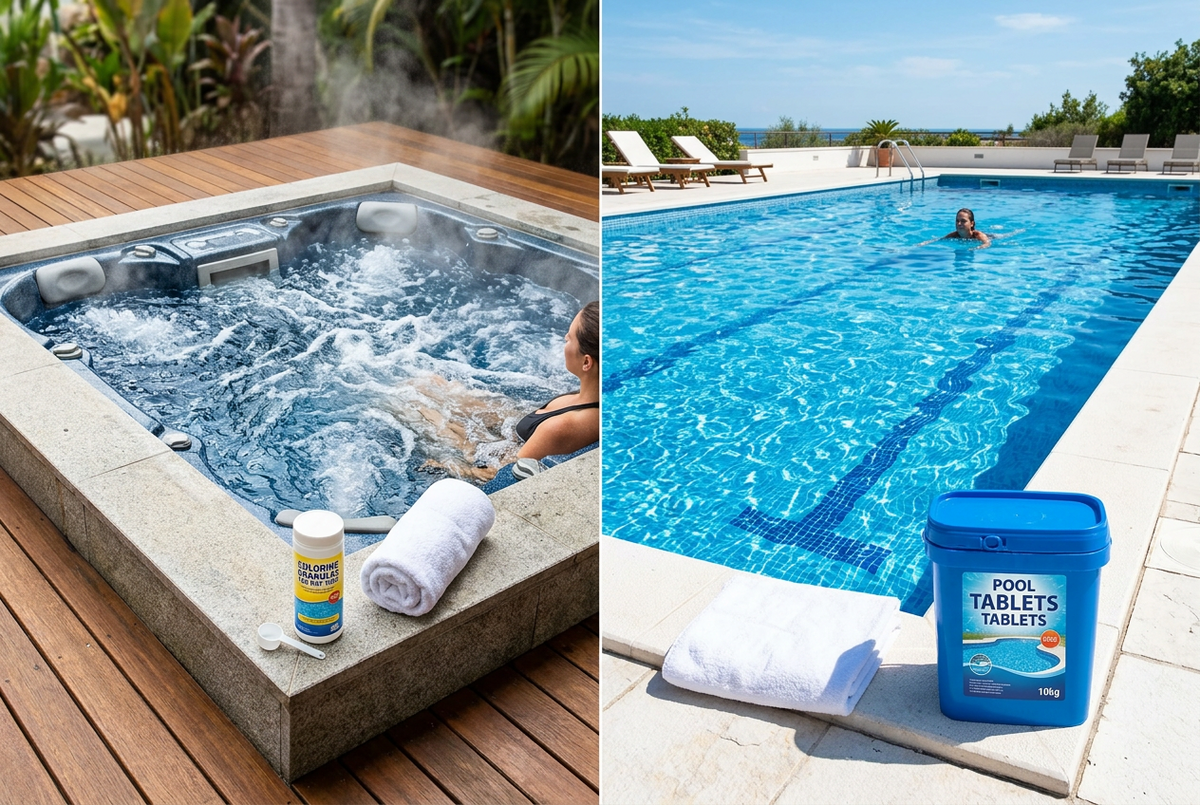
Hot tub chlorine vs pool chlorine comes down to three things: the type of chlorine, how fast it dissolves, and how much water it's made to treat. Most pool chlorine is sold as slow-dissolving 3-inch trichlor tablets or calcium hypochlorite shock, both made for pools holding thousands of gallons. Hot tub chlorine is usually fast-dissolving granular dichlor, measured for a few hundred gallons of hot water.
Using pool tablets in a hot tub can drop your pH, make the water corrosive, and damage the shell, jets, heater, and cover. Many hot tub manufacturers say trichlor can void the warranty. This guide explains the differences, which sanitizers are safe for a hot tub, and how to keep chlorine at the right level.
Quick Answer
· Don't use 3-inch pool tablets (trichlor) in a hot tub. They're very acidic and are made for large volumes of water.
· Use a spa-labeled sanitizer, such as granular dichlor, bromine, or a mineral system like FROG @ease.
· Keep chlorine at 3 to 5 ppm for traditional chlorine, or follow your product label. FROG @ease runs at just 0.5 to 1.0 ppm.
· Keep pH at 7.2 to 7.8 and test before each soak.
What Is the Difference Between Hot Tub Chlorine and Pool Chlorine?
The main difference is the type of chlorine and how it affects the water. Pool products are designed to release chlorine slowly into a large body of water. Spa products are designed to dissolve fast and work precisely in a small amount of hot water.
|
Chlorine type |
Common form |
pH in solution |
Where it's used |
|
Trichlor |
3-inch and 1-inch tablets, sticks |
Very acidic, about 2.8 to 3 |
Pools, in floaters, feeders, or skimmers |
|
Calcium hypochlorite (cal hypo) |
Pool shock, some tablets |
Very alkaline, about 10 to 12 |
Pool shock; adds calcium hardness |
|
Dichlor |
Fast-dissolving granules or spa tabs |
Near neutral, about 6 to 7 |
Hot tubs; also used as quick-dissolving pool chlorine |
Water volume matters too. A typical hot tub holds about 300 to 600 gallons, while a backyard pool may hold 15,000 gallons or more. A dose that barely registers in a pool can push a hot tub well past safe levels.
Why You Can't Use Pool Chlorine Tablets in a Hot Tub
Trichlor Can Throw Off Your Spa's pH
Most pool chlorine tablets contain trichlor, which has a pH of about 2.8 to 3. In a hot tub's small volume of water, it can quickly lower pH and total alkalinity and make the water corrosive. Over time, that can damage the shell, jets, heater, pump seals, and the underside of the cover. Low pH can also irritate skin and eyes.
Many hot tub manufacturers specifically warn against trichlor tablets, and some say using them can void the warranty. Before adding any sanitizer, check your owner's manual and use only the chemicals it recommends.
Slow-Dissolving Tablets Aren't Suitable for Small Spas
A 3-inch tablet is designed to dissolve gradually in a large pool. A hot tub holds much less water, so the tablet can release too much chlorine for the volume. If a tablet sits on the seat or floor, the concentrated chlorine can bleach or etch the acrylic. Some floating dispensers also get trapped under the cover, where chlorine gas can build up and damage the vinyl and foam.
Spa-specific products are made to dissolve quickly for controlled dosing. Some, like SpaGuard Rapid-Dissolve Chlorinating Tabs, come in tablet form but are designed to dissolve quickly in spa water. That's very different from a 3-inch pool tablet.
Which Chlorine Is Safe for a Hot Tub?
Granular Dichlor for Regular Sanitizing
Granular sodium dichlor is the most common chlorine for hot tubs. It dissolves quickly, is close to neutral pH, and works as both a sanitizer and an oxidizer when used as directed.
The CDC recommends at least 3 ppm of free chlorine in hot tubs, and many spa products target about 3 to 5 ppm. Label ranges vary, so always follow the directions on your container and your spa manufacturer's guidance.
How to add dichlor to your hot tub:
1. Test the water and adjust total alkalinity, then pH (7.2 to 7.8), first.
2. Turn on the jets or circulation pump and open the cover.
3. Measure the dose on the label for your hot tub's gallons. Never estimate with a pool-sized scoop.
4. Sprinkle the granules into the water near the filter area while the water is moving.
5. Run the jets for the time listed on the label, usually 15 to 30 minutes.
6. Retest before anyone gets in, and leave the cover open briefly after shocking.
One thing to know about dichlor: it contains cyanuric acid (CYA), a stabilizer. For every 1 ppm of chlorine dichlor adds, it leaves about 0.9 ppm of CYA in the water. CYA doesn't evaporate or break down, so it builds up and makes chlorine less effective over time. Draining and refilling is the only way to lower it, which is one reason regular water changes matter for chlorine hot tubs.
Low-Chlorine Mineral Systems
If you want chlorine sanitizing without the guesswork, a mineral system is a good option. The FROG @ease Floating Sanitizing System pairs minerals with self-regulating SmartChlor cartridges that keep chlorine at just 0.5 to 1.0 ppm, using up to 75 percent less chlorine than traditional methods. That means less chlorine odor, softer-feeling water, and no daily dosing. The SmartChlor cartridge lasts about 3 to 4 weeks, the mineral cartridge lasts about 4 months, and you shock about once a month with FROG Maintain. Shop the full FROG @ease collection.
Bromine as a Hot Tub Alternative
Bromine is another popular hot tub sanitizer. It stays active in hot water, is often gentler on the nose, and comes in slow-dissolving spa tablets used in a floater or in-line feeder. The CDC recommends a minimum of 4 ppm of bromine in hot tubs, and a typical target is 4 to 8 ppm. Mineral-assisted bromine options include the Spa FROG Serene Floating System. Browse our bromine collection.
Bromine still needs regular testing and periodic shocking. Never mix bromine and chlorine products in their dry or concentrated form, and store them separately in a cool, dry place away from children and pets. If you switch sanitizer types, drain, clean, and refill the hot tub. Systems like FROG @ease require a fresh fill if the hot tub was previously on bromine.
Can You Use Hot Tub Chlorine in a Pool?
Yes, dichlor can sanitize pool water, and some pool products are dichlor too, such as BioGuard Super Soluble Chlorinating Granules. But small spa containers are expensive for routine pool care, and granules don't provide the slow, steady release that tablets in a floater or feeder do.
Dichlor also adds cyanuric acid. In a pool, some CYA is useful because it protects chlorine from sunlight, but too much reduces chlorine's effectiveness. Pool owners using dichlor regularly should test CYA as well as chlorine. For routine pool care, products made for pools make dosing easier and more affordable.
How Water Volume and Heat Affect Chlorine Needs
A hot tub's small volume leaves little room for error. Adding a pool-sized dose can drive chlorine far above the desired level. At the same time, hot water, jets, skin oils, sweat, lotions, and heavy use can use up chlorine quickly.
· Heat: Water at 100 to 104 degrees speeds up chlorine loss and bacteria growth.
· Bather load: Four people in 400 gallons is a heavier load than a dozen swimmers in a 20,000-gallon pool.
· Aeration: Jets and air blowers release chlorine into the air and can raise pH.
· Covered water: A closed cover keeps out sunlight, so hot tubs don't need the UV protection that CYA provides in pools.
Test your water before each soak and at least two to three times a week, and add sanitizer according to the label. Easy-to-read FROG @ease Test Strips and our water testing collection make it simple to catch changes early.
Hot Tub Chlorine vs Pool Chlorine: Key Differences
|
Factor |
Hot tub chlorine |
Pool chlorine |
|
Common forms |
Granular dichlor, spa rapid-dissolve tabs, mineral systems |
3-inch trichlor tablets, cal hypo shock, liquid chlorine |
|
Dissolving speed |
Fast |
Tablets dissolve slowly over days |
|
Effect on pH |
Close to neutral |
Trichlor lowers pH; cal hypo and liquid raise it |
|
Dosing |
Small doses for 300 to 600 gallons |
Large doses for thousands of gallons |
|
Typical chlorine level |
3 to 5 ppm (FROG @ease: 0.5 to 1.0 ppm) |
1 to 3 ppm |
|
Stabilizer (CYA) |
Dichlor adds CYA; manage with water changes |
Often maintained for sun protection |
|
Best use |
Products labeled for spas and hot tubs |
Products labeled for pools |
Hot Tub and Pool Chlorine at Hot Tub Pirate
Hot Tub Pirate carries sanitizers for both hot tubs and swimming pools, so you can find the right product for your water.
For hot tubs, browse our hot tub chlorine collection, including:
· SpaGuard Chlorinating Concentrate and SpaGuard Rapid-Dissolve Chlorinating Tabs
· Leisure Time Spa 56 Chlorinating Granules
· Sirona Spa Care Chlorinating Granules and the Sirona Chlorine Start Up Kit
· SpaPure Spa Chlorinating Granules
· Low-chlorine FROG @ease floating and in-line systems
For pools, explore our pool chlorine collection, featuring BioGuard and Poolife tablets and shock, plus FROG pool systems like Pool FROG Bac Pac cartridges and the Flippin' FROG Floating Pool Sanitizing System.
Conclusion
The difference between hot tub chlorine vs pool chlorine comes down to the chemical type, how it dissolves, and the volume of water it's made for. Pool tablets are too acidic and too concentrated for most hot tubs, while granular spa chlorine and low-chlorine systems like FROG @ease are made for small amounts of hot water. Choose a sanitizer approved for your spa, follow the label, and test regularly to keep your water clean, comfortable, and safe.
FAQs
Can I use 3-inch chlorine tablets in my hot tub?
No. Most 3-inch pool tablets are trichlor, which is very acidic and dissolves too slowly and unevenly for a hot tub. It can lower pH, corrode equipment, damage the shell and cover, and may void your warranty. Use a sanitizer labeled for spas.
Is dichlor or trichlor better for a hot tub?
Dichlor. It dissolves quickly and is close to neutral pH, while trichlor is highly acidic. Always follow your spa manufacturer's recommendations and the product label.
How often should I test chlorine in my hot tub?
Test before each soak and at least two to three times a week, plus after heavy use. Adjust sanitizer and pH based on your results and the product instructions.
Can I use hot tub chlorine in my swimming pool?
Yes, dichlor can sanitize pool water, but spa-size containers are expensive for large volumes and dichlor adds cyanuric acid over time. Pool-specific products are usually better for routine pool care.
What chlorine level should a hot tub have?
The CDC recommends at least 3 ppm of free chlorine in hot tubs, and many spa products target 3 to 5 ppm. With the FROG @ease system, chlorine stays at a steady 0.5 to 1.0 ppm because the minerals help do the work.
Can I use pool shock in a hot tub?
It's best not to. Calcium hypochlorite pool shock raises pH and adds calcium hardness, which can lead to cloudy water and scale in a hot tub. Use a spa shock instead, such as dichlor or a non-chlorine shock like FROG Maintain.
Can I use liquid chlorine or bleach in a hot tub?
Liquid chlorine is very alkaline and raises pH, and household bleach may contain additives. Stick with sanitizers labeled for spa use unless your manufacturer approves another product.
Why does my hot tub chlorine stop working even when I add more?
Dichlor builds up cyanuric acid over time, which slows chlorine's ability to sanitize. If chlorine seems weak despite regular dosing, test CYA and drain and refill the hot tub if it's high.